
June 19 settlements: Gold cracks $4,200 EMA, oil rebounds on Vance's cancelled Iran trip, CBOT dark for Juneteenth
Gold GCQ6 −1.30% to $4,172.90 breaking 200-day EMA; Brent +1.65% to $80.57 / WTI +1.17% $77.54 on Vance-Geneva cancellation; CBOT closed Juneteenth; China 504K MT soybean buying paused.

Data cutoff: 10:00 PM ET, June 19, 2026 — abbreviated Juneteenth electronic session; CBOT grain markets closed all day
Three pressure systems collided Friday. The hawkish Fed repricing that started with Chair Kevin Warsh's June 17 FOMC pushed gold through its 200-day EMA for the first time in months, with GCQ6 losing $55 in a single session to $4,172.90. Oil reversed course when VP JD Vance scrapped his Geneva trip, snapping a multi-day decline: Brent BZN6 reclaimed $80.57 and WTI CLN6 settled at $77.54. And CBOT corn and soybeans went dark for the Juneteenth federal holiday, leaving the China soybean buying story in limbo at 504,000 MT across two days — with no Day 3 flash sale to confirm or deny Beijing's intent.
Settlement table — June 19, 2026
| Market | Contract | Settlement | Day Δ | % |
|---|---|---|---|---|
| COMEX Gold | GCQ6 (Aug) | $4,172.90 | −$55.00 | −1.30% |
| NYMEX WTI | CLN6 (Jul) | $77.54 | +$0.90 | +1.17% |
| ICE Brent | BZN6 (Aug) | $80.57 | +$1.31 | +1.65% |
| CBOT Corn | ZCN6 (Jul) | Closed — Juneteenth | — | — |
| CBOT Soybeans | ZSN6 (Jul) | Closed — Juneteenth | — | — |
| COMEX Copper | HGN6 (Jul) | $6.3370 | −$0.0485 | −0.76% |
CBOT grain markets will reopen with the Sunday overnight session. Last available grain prices are Jun 18: ZCN6 417.50¢ (9-month low), ZSN6 1,122.00¢ (4-month low).
| Macro | Jun 18 | Jun 19 | Δ |
|---|---|---|---|
| DXY | 100.82 | ~100.74 (intraday high 101.13) | New 52-week high |
| 10Y Treasury | 4.460% | 4.488% | +2.8 bp |
| S&P 500 | 7,500.58 | Closed (Juneteenth) | — |
| E-mini S&P (electronic) | — | 7,556.25 | −0.19% |
| CME Sept hike prob. | ~67% | ~51.7% | −15.3 pp |
Gold: Day 3 of the Warsh rout, EMA gives way
The $4,200 level had been a line in the sand. It held during two prior sessions after the FOMC. It didn't hold Friday.
GCQ6 opened at $4,231.20 and printed a session low of $4,138.70 before settling at $4,172.90 — down $55.00, or 1.30%. 1 That break put gold below the 200-day EMA for the first time since mid-March, and the three-session drawdown from the June 16 Iran-deal peak of $4,354.20 now stands at roughly $199.50, or −4.58%. 2 Friday also marked gold's third consecutive weekly loss and — by most tallies — a fourth consecutive monthly loss.
Spot gold traded around $4,154.70, with the bid tracking below futures throughout the abbreviated session. 3
The macro setup could hardly be more hostile to a non-yielding metal. The WSJ noted Friday that "Federal Reserve policymakers sounded an increasingly hawkish tone, supporting the greenback and sparking a pullback from non-yielding precious metals." 4 The DXY hit 101.13 intraday — a new 52-week high, its loftiest level since May 2025 — before settling around 100.74. 5 The 10-year yield ticked up another 2.8 basis points to 4.488%. When dollar and real rates both rise, gold typically reprices lower; Friday was a textbook execution of that dynamic.
Wall Street moved to mark its books accordingly. Goldman Sachs cut its end-2026 gold target from $5,400 to $4,900 per ounce, citing the revised federal-funds-rate outlook. 2 JPMorgan is reported to have trimmed its forecast from $5,708 to $5,243, but simultaneously issued a buy-the-dip call at a $4,320 entry with a $5,000 target — meaning even the cuts are hedged. The CME FedWatch tool showed the probability of a September hike sliding from roughly 67% on Thursday to 51.7% by Friday, a 15-point drop that suggests some traders unwound their most hawkish positioning going into the weekend. 2 6 That partial repricing is worth watching: gold often bounces when short-covering coincides with thin holiday tape.
Laurence Booth, global head of markets at CMC Markets, characterized the slide as "less about panic selling" — the decline has been orderly despite the $200 drawdown. 2 In his reading, the more consequential signal is physical: premiums in China and other major Asian markets have softened, removing a source of support that had insulated gold during prior corrections. Fawad Razaqzada of City Index went further: with momentum bearish, the dollar still elevated, and safe-haven flows from the Iran deal fading, gold could test sub-$4,000 if the $4,100 level breaks. 7 The next hard floor is the March 2026 low at approximately $4,023, followed by the $4,000 psychological round.
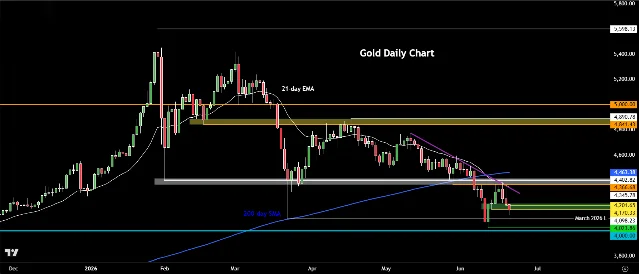
One counterpoint: KenMacro flagged that gold is "deeply oversold into a thin Juneteenth holiday tape" — that exact combination has historically produced short-covering rallies. 8 With volume at 73,110 contracts and open interest at 265,519 on Friday, the market is liquid enough that a weekend reversal catalyst — a conciliatory Fed speaker, a stumble in the dollar — could flush shorts quickly. That doesn't change the trend; it just means the path lower probably won't be straight.
Oil: Vance bails on Geneva, Brent bounces back above $80
The day's oil trade was a Rorschach test of geopolitical risk premium. Brent had been sliding all week — down roughly 7.4% over five sessions — as Hormuz traffic resumed and the June 18 Versailles MOU between the US and Iran locked in. Then VP JD Vance cancelled his Geneva trip, and the market repriced upward fast.
The WSJ's pre-dawn note set the tone: "Brent crude oil rose back above $80 a barrel after U.S. Vice President JD Vance called off plans to travel to Switzerland for peace talks with Iran." 9 ICE Brent BZN6 (August) settled at $80.57, up $1.31 (+1.65%), after printing a session high of $80.81 and a low of $78.77. 10 NYMEX WTI CLN6 (July — expiring June 22, three days out) settled at $77.54, up $0.90 (+1.17%), with CLQ6 (August, the active forward contract) closing at $76.54. 11 12
The cancellation came against a backdrop of renewed fighting. Israel struck Lebanon's south and Bekaa Valley overnight, killing 47 people and wounding 97 — the deadliest single day since March — after Hezbollah used guided missiles to destroy three Israeli tanks and kill four soldiers, including a battalion commander. 14 A US-brokered ceasefire took effect at 4:00 PM local time; Trump told NBC "you just gotta calm down sometimes and use your head." 15 Even after the ceasefire, at least 12 Israeli strikes were reported around Nabatieh, per BBC.
Iran's foreign ministry spokesman Esmaeil Baghaei framed the cancelled Switzerland talks as a non-event: "Given that the MOU was electronically signed on June 18, there is no urgency to hold a meeting in Switzerland." 15 The next formal session is unscheduled. Trump, departing for Camp David, posted on Truth Social: "They are FINISHED! We'll play out the 60 days. They get no money, not ten cents!" 16
Hormuz: 7 supertankers sail, IRGC still fires warning shots
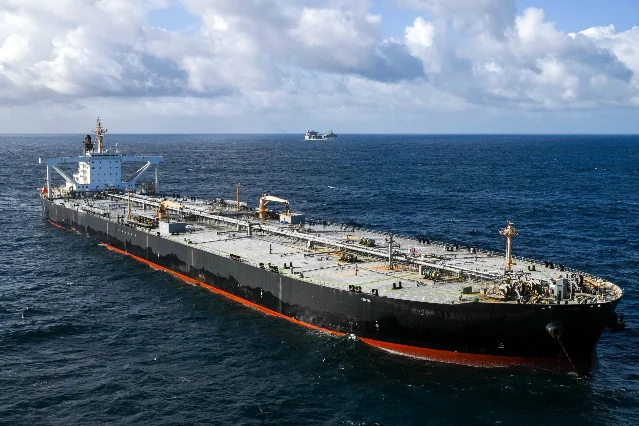
Despite the Brent rally, the underlying Hormuz story is more textured than the headlines suggest. Friday saw seven Iranian supertankers — roughly 14 million barrels of cargo capacity — depart Chabahar, the largest single-day surge since the blockade lifted. The prior two days combined had produced only four. This week's total: 11 tankers moving more than 20 million barrels toward Asian buyers, primarily Chinese independent refiners. 17 Commercial transits through the Strait numbered 25 on June 18 — the highest single-day count since April 18 and more than five times the daily average for the first ten days of June — though still far below the pre-conflict rate of roughly 120 per day. 18
The normalization comes with conditions. Iran's Persian Gulf Strait Authority (PGSA) issued new transit rules requiring ships to carry a PGSA-issued permit (valid single-trip, expiring in five days), use a specific channel near Larak Island, and purchase PGSA-approved insurance — free for now, but with Iran reserving the right to charge later. 19 The US Treasury sanctioned the PGSA on May 27, accusing it of operating as an IRGC extortion mechanism — which makes the practical question of who ship operators are paying for "insurance" genuinely murky.
At 12:29 UTC Friday, the IRGC broadcast on Marine Channel 16 that the Strait "will remain closed until Israel's withdrawal from Lebanon, the complete lifting of the naval blockade, and the departure of American terrorist forces from the Persian Gulf." IRGC vessels then fired warning shots at ships in the waterway. INTERTANKO Managing Director Tim Wilkins told gCaptain: "This is not freedom of navigation. It is chaos." 19 The Joint Maritime Information Centre (JMIC) downgraded its Hormuz threat assessment to SUBSTANTIAL — a meaningful step down — but P&I insurers have not restored underwriting, and war-risk premiums remain around 30 times normal levels. 20 Mine-clearance operations by US Navy Avenger-class vessels are ongoing with no confirmed completion timeline.
The picture for oil: the relief rally from Hormuz normalization is real, but so is the re-risk premium from IRGC warning shots, an un-insurable passage regime, and an as-yet-unsigned final Iran deal. EIA data through June 12 showed US crude inventories fell 8.3 million barrels to 418.2 million barrels — the lowest in 40 years, a tenth consecutive weekly draw — which gives oil a fundamental floor even as geopolitical froth cycles in and out. 21 Bank of America's current range forecast, assuming a full Hormuz reopening, is $70–$80 for Brent. Friday's $80.57 settlement sits at the top of that range. 22
One further supply-side pressure point: Ukraine's largest drone strike of the war, on June 18, targeted Moscow's Kapotnya refinery (11 million metric tons annual capacity, supplying roughly a third of the Moscow region's fuel). The city's mayor reported 180 drones were intercepted. Russia's refinery run rate has fallen to below 4 million barrels per day — a 21-year low. More than 25 regions now have fuel rationing in place; Tatneft implemented a 30-liter-per-vehicle cap nationwide. 23 24 This removes Russian refined product from global supply at the margin — a structurally bullish secondary factor for distillate spreads.
Grains: CBOT dark; China's 504K MT soybean run paused
CBOT corn and soybeans did not trade Friday. No settlement price, no open interest update, no flash sales. The Juneteenth federal holiday halted all CBOT activity; trading resumes with the Sunday overnight session. 25
That pause came at a charged moment. China's 127-day US soybean zero-purchase streak 26 — which ran from early February — broke across two consecutive sessions: 372,000 MT on June 17 (to "unknown destinations") and 132,000 MT to China plus 120,000 MT to unknown buyers on June 18, totaling 504,000 MT over two days. 25 Beijing's trade deal pledge calls for 25 million metric tons in the 2026–27 marketing year; the USDA's own baseline only embeds 15 million — a 10-million-ton credibility gap that traders are now watching to see if purchases fill. 27
Whether Beijing is actually behind the purchases is contested. Ted Seifried of Zaner Ag Hedge told AgWeb: "I do think it was China. You know, they like to play their unknown destination game." 28 Arlan Suderman, StoneX's chief commodities economist, was less convinced: "We doubt that that's China. It may be, but we believe it may be European business." 27 The confirmation typically arrives only once freight is arranged and the "unknown" buyer is formally identified. Sunday night's opening will be the first read on whether momentum carries through.
The week's export sales numbers, released Friday morning before CBOT opened (the data is a USDA release, not exchange-traded), gave traders something to work with. For the week ending June 12: soybean old-crop sales came in at 424,900 MT — up 49% from the prior four-week average and well above the 211,300 MT in the prior week. Corn old-crop sales hit 1.16 million MT, up 16% week-over-week. Wheat 2026–27 sales were 400,800 MT. 25 28 Jody Lawrence of Helena Agri-Enterprises summarized: "The weekly numbers were better than expected and continue to show end user and world importer interest after the early June price break." 29
Those soybean prices were at their lowest in four months. The bearish force underneath is a global grain buffer that sits at or near multi-year records: global wheat beginning stocks at 279.95 million metric tons (a five-year high); corn inventories projected at 303.4 million tons (three-year high); soybeans at 125.5 million tons (just below last year's record of 126 million); world milled rice at an all-time high of 196.16 million tons. 30 FAO economist Shirley Mustafa noted "there is a bit of silver lining as far as global stocks and recent harvests of rice and other cereals is concerned." 30 Those buffers cushion El Niño risk, though Iowa PBS's Karen Braun cautions that "El Niño in summer is not really a big story for the US" — the key weather window for US corn is July. 26
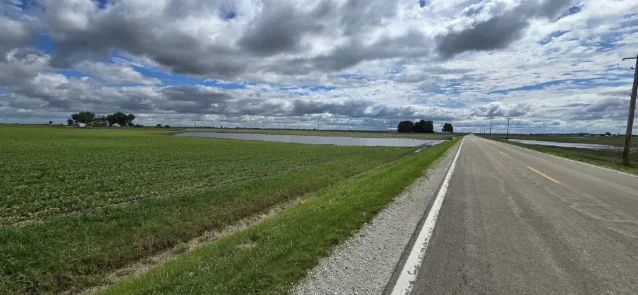
The less-covered threat in the Corn Belt right now is the wet side. Illinois received 5 to 6+ inches of rain across 12 days in LaSalle, Grundy, Edgar, and Iroquois counties. Soils are saturated, standing water has been present for over a week in the worst areas, and some fields face near-total losses from extended ponding. Flood watches are active for northeast Kansas and northwest Missouri. 31 Jody Lawrence put it plainly: "Dry and hot gets headlines, but wet and cool will factor negatively into final yield." 29 Fund positioning reflects the bear: funds are net short 75 million bushels of corn and 340 million bushels of wheat, though they hold a long of over 500 million bushels in soybeans. 29
Copper: Cobre Panama passes audit at 88%
COMEX HGN6 (July) settled at $6.3370 per pound, down $0.0485 or 0.76%, pulling back within a $6.2700–$6.3818 daily range on volume of 17,810 contracts. 32 The two-day slide from Thursday's $6.4935 high amounts to −$0.1565 (−2.4%), tracking the broad dollar-strength drag that also hammered gold.
The week's structural copper story is in Panama. Panama's government released a long-awaited environmental audit of First Quantum Minerals' (First Quantum Minerals, a Canadian mining company) shuttered Cobre Panama mine — one of the world's largest copper operations before it was closed in late 2023 following protests — and the mine scored 88% compliant. 33 Trade Minister Julio Molto said "the decision will be based on data, evidence and technical rigor." Scotiabank expects the results to support a presidential recommendation to fully restart, with First Quantum retaining operatorship under renegotiated fiscal terms that include a higher tax and royalty burden and a potential 5% Panama ownership stake. Cobre Panama contributed roughly 5% of Panama's GDP before its closure.
A separate copper supply issue emerged Friday out of Chile. Capstone Copper identified significant groundwater impacts at its Mantos Blancos mine in the Atacama: the water table has risen up to 40 meters in one sector, and mining operations have altered water quality. Capstone plans an environmental impact assessment submission by end of June for an expansion to 27,000 metric tons per day, with water-control measures proposed for up to 25 years. 34 Neither item is a near-term copper-supply shock, but both feed into the long-duration supply-deficit thesis — Jefferies has put a 491,000-ton annual deficit through 2030 on the table — that has kept the HG contract trading above $6 all year. 32 34
What to watch next week
- Gold: Whether $4,100 holds. Below that, the next hard reference is the March 2026 low near $4,023. A Fed speaker or softer macro print could trigger short-covering; the trend remains bearish until DXY reverses or rate-hike odds retreat materially.
- Oil: CLN6 (July) expires June 22 — Monday. Expect elevated roll volume. The Iran deal's next checkpoint is unclear; Trump's 3–5 day ultimatum to Tehran effectively puts a clock on Monday–Wednesday. Any IRGC escalation in the Strait or collapse in Lebanon ceasefire terms would re-price Brent above $83.
- Grains: Sunday overnight open is the first chance for a China Day 3 soybean flash sale. USDA crop progress (Monday after hours) will give the first condition update since the Illinois flooding began.
- Copper: Watch for Panama's president to act on the Cobre Panama audit recommendation. A formal restart authorization would be the largest mine-restart event in copper in years.
Data sourced from market closes and sources available by 10:00 PM ET, June 19, 2026. CBOT grain settlements, US equity cash markets, and US bond cash markets were closed for the Juneteenth federal holiday.
References
- 1Kitco: Gold, silver extend losses with US markets shut for Juneteenth
- 2Kitco: Hawkish Fed keeps pressure on gold as physical premiums soften
- 3MarketWatch: GC00 Gold Continuous Contract
- 4WSJ: Dollar Rises to One-Year High, U.S. Markets Closed for Holiday
- 5Investing.com: DXY US Dollar Index
- 6CNBC: @GC.1 Gold COMEX Aug'26
- 7City Index: Gold outlook — could XAU/USD be heading sub-$4,000?
- 8KenMacro: Gold Forecast — XAU/USD Falls to $4,120, 3rd Weekly Loss
- 9MarketWatch: CLN26 Crude Oil Jul 2026
- 10CNBC: @LCO.1 ICE Brent Crude Aug'26
- 11CNBC: @CL.1 WTI Crude Jul'26
- 12MarketWatch: BRN00 Brent Crude Oil Continuous Contract
- 13gCaptain/Bloomberg: Iran Oil Surges as Seven Supertankers Sail After Blockade Lifts
- 14BBC News: Israel and Hezbollah agree ceasefire, US says
- 15The Guardian: 'You just gotta calm down' — Trump live blog June 19
- 16PBS NewsHour: Israel and Hezbollah renew ceasefire after US and Iran call off talks
- 17gCaptain/Bloomberg: More Than 20 Million Barrels Leave Iran as Post-War Oil Trade Reawakens
- 18gCaptain/Reuters: Oil Shipments Rise in Hormuz Although Questions Grow Over Iran's Transit Terms
- 19gCaptain/LaRocco: Iran's New 'Toll by Insurance' Raises Stakes in Strait of Hormuz
- 20House of Saud: Hormuz Was Downgraded — the Insurance Market Wasn't
- 21EIA: Weekly Petroleum Status Report
- 22Anadolu Agency: Oil slips below $80 as easing geopolitical tensions shift outlook
- 23RFE/RL: Gas Shortages Hit Russia As Ukraine Hits Refineries
- 24gCaptain: Iran Asserts Control Over the Strait of Hormuz
- 25Successful Farming: 3 Big Things Today, June 19, 2026
- 26Iowa PBS: Market to Market, June 19, 2026
- 27StoneX: China's US Soybean Pledge Faces a 10-Million-Ton Credibility Test
- 28AgWeb: Grains End Higher on Soybean Export Biz as China Also Looks for Corn and Wheat
- 29Helena Agri: China Demand and Market Stabilization Spark Hope After Brutal June Selloff
- 30Reuters: Ample world inventories may soften El Nino food supply shock
- 31University of Illinois farmdoc: Illinois Crop Update, June 19, 2026
- 32Investing.com: Copper Futures Historical Prices
- 33Reuters: First Quantum's shuttered mine passes audit, as Panama weighs restart
- 34BNN Bloomberg/Reuters: Capstone Copper identifies groundwater issues at Chile mine
Add more perspectives or context around this Post.